
Exploring the Hidden Charm of the Butte-aux-Cailles and the Cité Florale in Paris

The 13th arrondissement of Paris is located to the south and west of the Seine as the Seine curves around the city. It has a considerable Chinese and Vietnamese population and is largely a working-class neighborhood. One beautiful spring morning I took a stroll through part of it and was delighted by its calm and charm.
One of the many Asian restaurants in this area.

I concentrated on the Butte-aux-Cailles section of the arrondissement. Literally, "Butte aux Cailles" translates to Quail Hill, but the name actually originates from landowner Pierre Caille who bought a vineyard there in the 16th century. My route is below; beginning at the métro Maison Blanche in the lower right-hand corner, I headed west on the rue de Tolbiac.

If you are interested in the Wallace fountains, I came across a blue one, unusual because most are dark green. Unfortunately it was surrounded by construction fences, but interesting nevertheless. These fountains were installed in the mid 19th-century by Paris resident Sir Richard Wallace to provide fresh drinking water to Paris residents and are still used today.

Jardin Charles Trenet

This little body of water is a conservation effort to supply an environmentally-friendly habitat for water birds and plant life.

Cité Florale

Tucked into the southwestern corner of the 13th arrondissement, the Cité Florale is a quiet oasis of cobblestone lanes and lush greenery.

Built in the 1920's over what used to be the Bièvre River, the architecture is more reminiscent of a country village than a typical Parisian neighborhood. The Bièvre is considered Paris's "lost" river. Once flowing past industrial complexes, it became badly polluted and was eventually paved over by 1912. The unstable ground created by the Bièvre wasn't suitable for the larger Haussmannian architecture prevalent in so much of Paris, so the two-story houses and quiet lanes create a charming neighborhood ideal for strolling. This is truly one of my favorite areas of Paris.


I stopped at Laurent Duchêne, a lovely little pâtisserie, for some sugary fuel.

Head east on the rue Daviel and you'll soon come across La Petite Alsace (Little Alsace), a former workers' housing development built in 1912. An unexpected but welcome sight in the middle of Paris!

Villa Daviel

The Villa Daviel is a short dead end street just opposite La Petite Alsace. Also built in 1912 to provide homes to workers in the area, it's now a well-manicured lane of picturesque and beautifully maintained brick houses.
Street Art

The 13th arrondissement has no lack of interesting street art. Here are just a few examples.

Continue heading east on the rue de la Butte aux Cailles and you'll come upon two small but lovely squares; the Square Henri Rousselle and the Place Paul Verlaine.

The Wallace Fountain below, known as the hydrant or small model, is the traditional green and still supplies clean drinking water.

The building below is the Butte aux Cailles swimming pool. Built in 1924, its art nouveau style blends well with the ambiance of the neighborhood.

Listed as a historic monument, it houses three pools; an indoor pool, an outdoor Nordic pool and a children's pool. It's located on the site of an old mill and in 1946, during work on the site, a below-ground hot water source was found which supplies 82 degree heat to the Nordic pool year-round.

The Place Paul Verlaine is home to an artesian well. The worn writing on the well says that it was conceived by Baron Haussmann, the architect of modern Paris in 1863. It was given to the residents of the 13th arrondissement to compensate for the disappearance of the heavily polluted Bièvre River. It still provides clean drinking water.

Le Square des Peupliers

Paris is full of delightful surprises and this is one, at least for me. You would be forgiven if you walked past it without noticing; it's well tucked-in. Le Square des Peupliers is south of the rue Tolbiac off the rue du Moulin des Prés. It's a beautiful little enclave of homes surrounded by flowers that were plentiful when I was there. If you're in the area, take a few minutes to enjoy this pristine micro neighborhood.
Some interesting architecture near the Square des Peupliers.


Rue Dieulafoy

Just a few minutes from the hustle and bustle of the major streets that surround it, rue Dieulafoy is another quiet and picturesque lane. The houses that line the cobblestone way are beautifully maintained and most are partially hidden by flowers and greenery.
Square de l'Abbé Georges Hénocque

This quiet park was my last stop in the Butte-aux-Cailles. It was a quiet, uncrowded place to rest before taking the métro back.
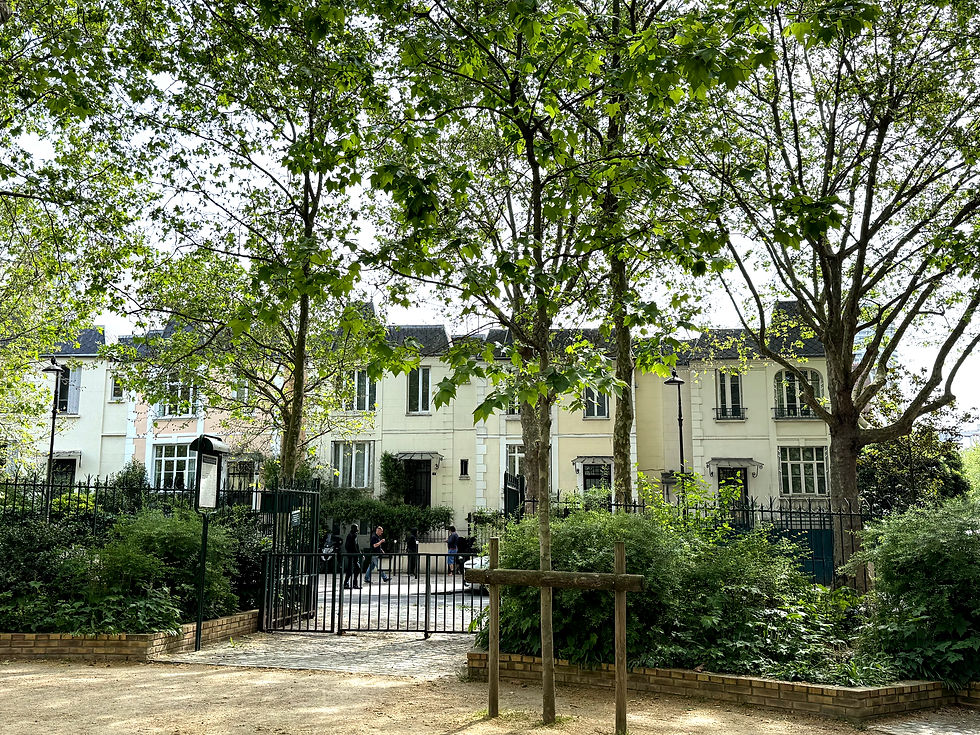

My morning in this part of the 13th arrondissement only made me want to return. Its charm and authenticity were a breath of fresh air.
➜ Top Tips
If you visit this part of Paris, try to go on a sunny day in late spring, summer or fall to appreciate the beautiful flowers.
Allow at least two hours for a leisurely stroll.
Although I didn't try any of the Asian restaurants, my guess is that you can't go wrong with most of them.
I began at métro Maison Blanche (lines 7 and 14), but you could also start at Corvisart (line 6), Place d'Italie (lines 5, 6 and 7), or Tolbiac (line 7)


Thank you for this clear and informative article. The subject is explained in a straightforward way, making it easy to understand. Content like this is helpful when learning about how digital media platforms are evolving. porn
seo seo seo seo seo seo seo seo seo seo seo seo seo seo seo
Beautiful photos and a lovely narrative!