
The Incredible Basilica of Saint-Denis, Paris

Located in a somewhat rough and tumble suburb north of central Paris, Saint-Denis has a long and rich history.
The story of Saint-Denis is long and complex. After all, it's a church, a museum and a necropolis all in one. The French name for it is Basilique cathédral Saint-Denis. So it's a basilica and a cathedral? I had to refresh my memory as to the difference, so I turned to Google. It says, "A cathedral is the principal church of a diocese, serving as the seat of a bishop, while a basilica is a church granted special privileges by the Pope for its historical, architectural or spiritual significance." There's no doubt about the historical, architectural and spiritual significance of Saint-Denis!
History
Saint Denis, the first Bishop of Paris, lived in the 3rd century. He was sent by Pope Fabian to evangelize the citizens of Parisii, the Gallic tribe in what is now Paris. The Roman authorities condemned and decapitated him along with two of his followers. The legend is that he carried his head from Montmartre north about four miles to the present site of Saint Denis where he said he wanted to be buried.


A shrine was built over his grave in the early 4th century and Sainte-Genviève, the patron saint of Paris, enlarged it in the 5th century by adding royal tombs at which point it was considered a basilica. The church maintains this honorary title having never been formally designated a basilica. Since then it has housed the remains of almost every king of France from the 10th century to Louis VXIII in the 19th century. The relics of Saint Denis himself are enclosed in a gilded shrine and occupy a prominent place today in the church behind the main altar. In 1966 the church was designated a cathedral by Pope Paul VI.

In the 7th century Dagobert I, king of the Franks, transformed the basilica into the Abbey of Saint Denis, a monastery which housed over 500 monks. It was he who commissioned the new, gilded shrine to contain the remains of the saint.
Dagobert himself is buried at Saint-Denis in a beautifully intricate tomb. The tomb sits above the original burial site.
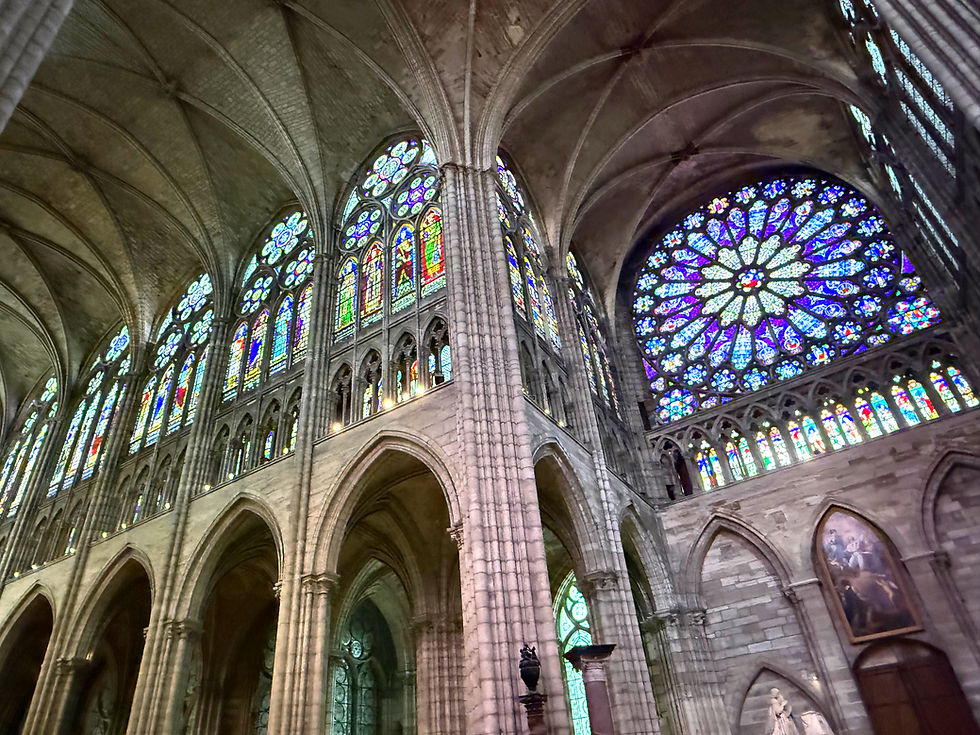
Fast forward to the early 12th century when the Abbot and statesman Suger raised the money to modernize and enlarge the abbey which was in poor physical shape and struggling to accommodate the number of pilgrims visiting the tomb of Saint Denis. He commissioned a major reconstruction to be carried out to enlarge and modernize it. As a result, Suger is recognized as the father of Gothic architecture.
Reconstruction and modernization continued through the centuries long after Suger's death and the stunning Gothic elements are evident today throughout the church.


The Museum and Necropolis
The basilica itself is free to visit, but if you go on your own, pay the additional cost to visit the museum which contains the necropolis. I also rented an audioguide which was very informative and which I recommend to enhance your visit. As mentioned above, almost every king of France through Louis XVIII - and numerous family members - are entombed there. In fact, 42 kings, 32 queens and 63 princes are buried here. In addition to the tombs, this area contains a number of cenotaphs.
The photos below are part of what you'll see when you enter the museum/necropolis.

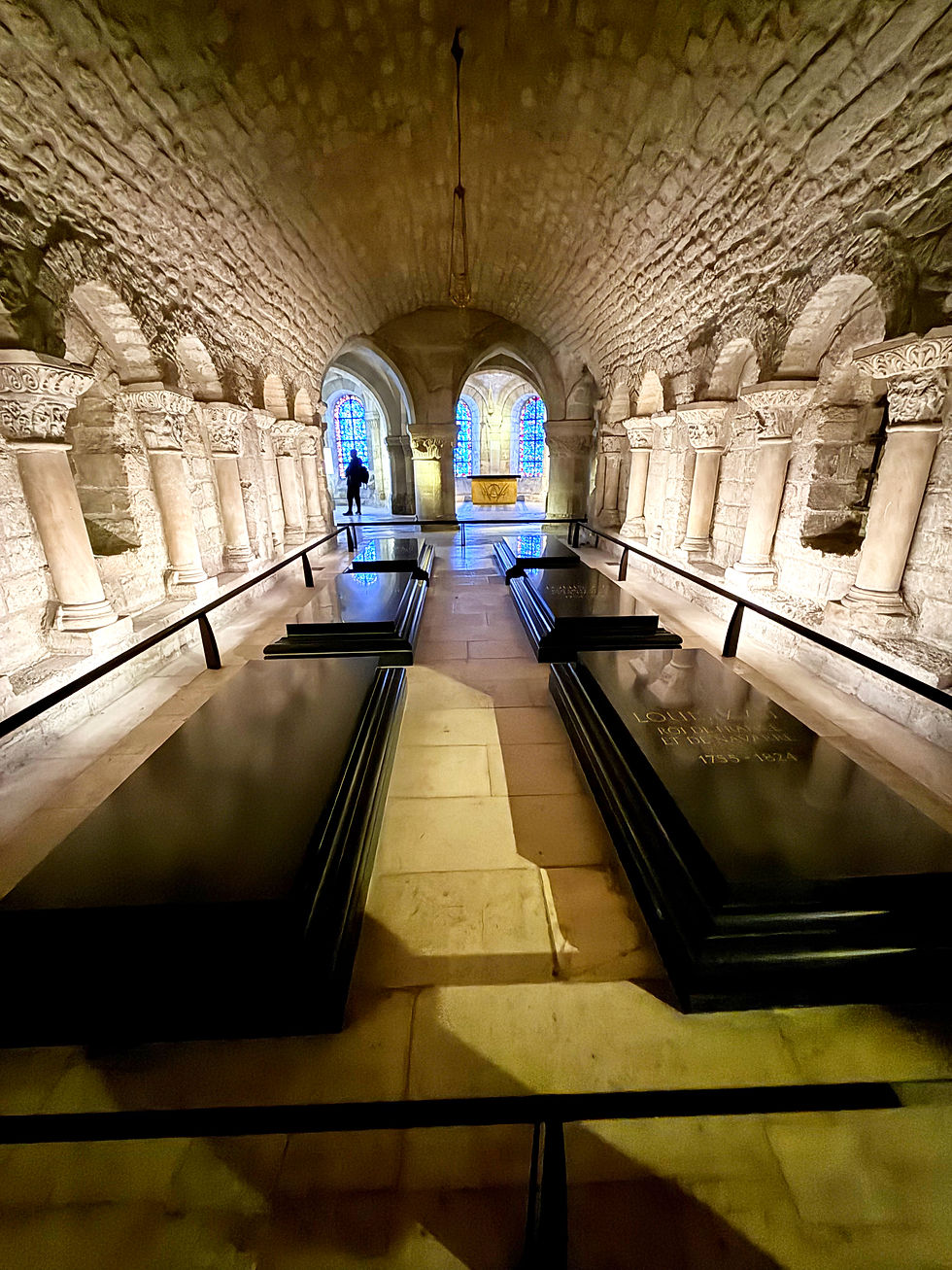
Walk down a few steps and you'll find yourself in the crypt. Known specifically as the archeological crypt, this is the oldest section of the church which dates from about 775 CE. For me, this was one of the most interesting parts of the visit.
Much of what we know now about the fascinating history of this basilica comes from Sumner McKnight Crosby, and American art historian and archeologist. He graduated from Yale University in 1932 and obtained his Ph.D from Yale in 1937 having published his doctoral thesis on the Basilica of Saint-Denis. His yet-to-be completed studies on Saint Denis were published in 1987, five years after his death.


Just opposite are the tombs of Louis XVI and Marie Antoinette under these black marble slabs. Not originally buried here, their remains were transferred from the Madeleine cemetery in Paris by Louis XVIII in 1815. Also notice the beautiful columns whose capitals illustrate scenes from the Bible and from the life of Saint Denis.
This room is called Chapel of the Princes. It contains the remains of various royal family members. The cabinet on the far wall contains urns which hold the hearts of Louis XIII, Louis XIV and Louis XVIII and fragments of the bodies of other kings.


Below is a bas-relief of the young Louis XVII who died from tuberculosis at the age of 10. In 2000, thanks to DNA analysis, the heart enclosed in the glass below was confirmed to be that of Louis.

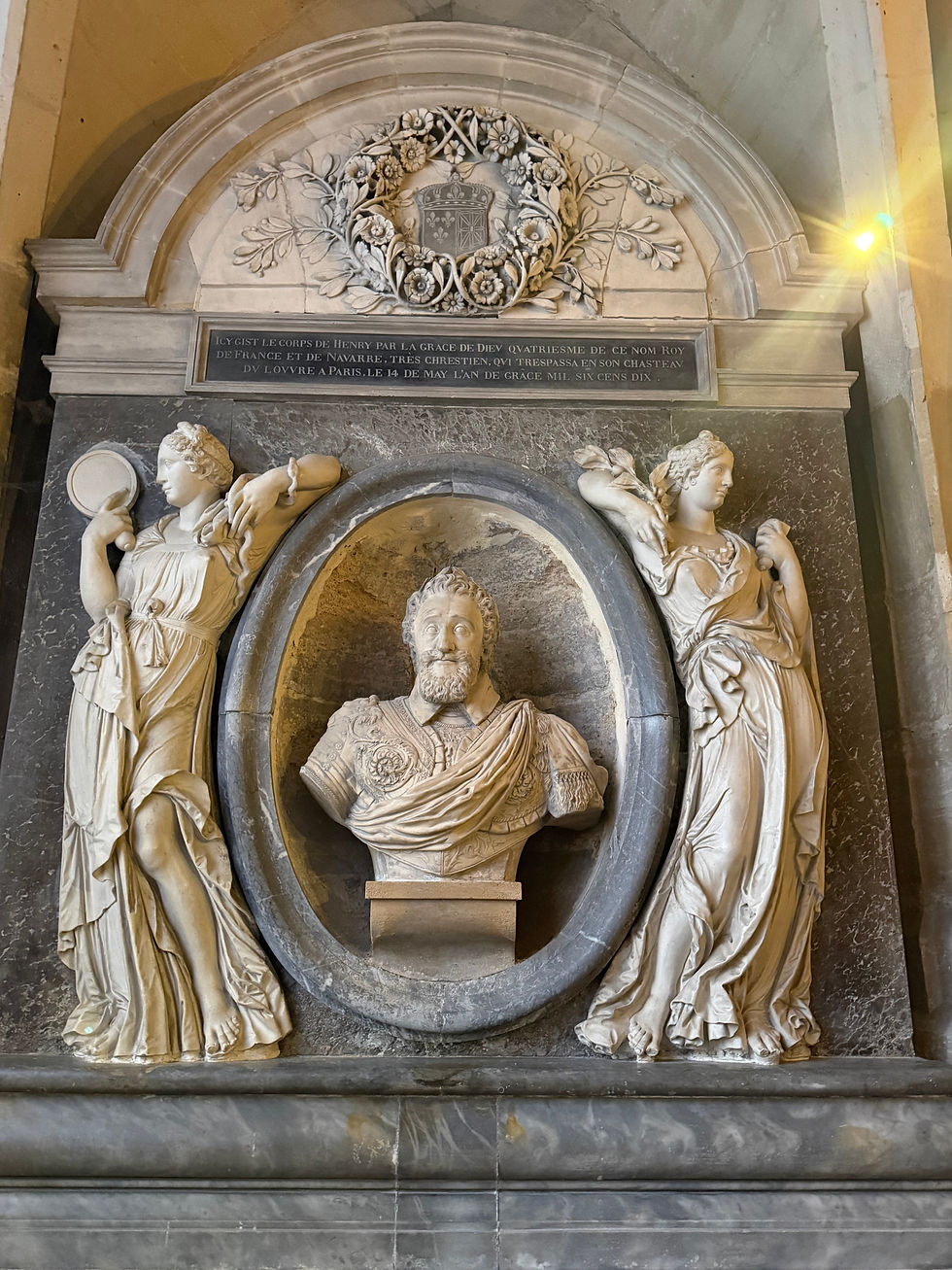
A tribute to Henri IV who is buried in the crypt.
Other areas in the crypt including the royal ossuary immediately below.
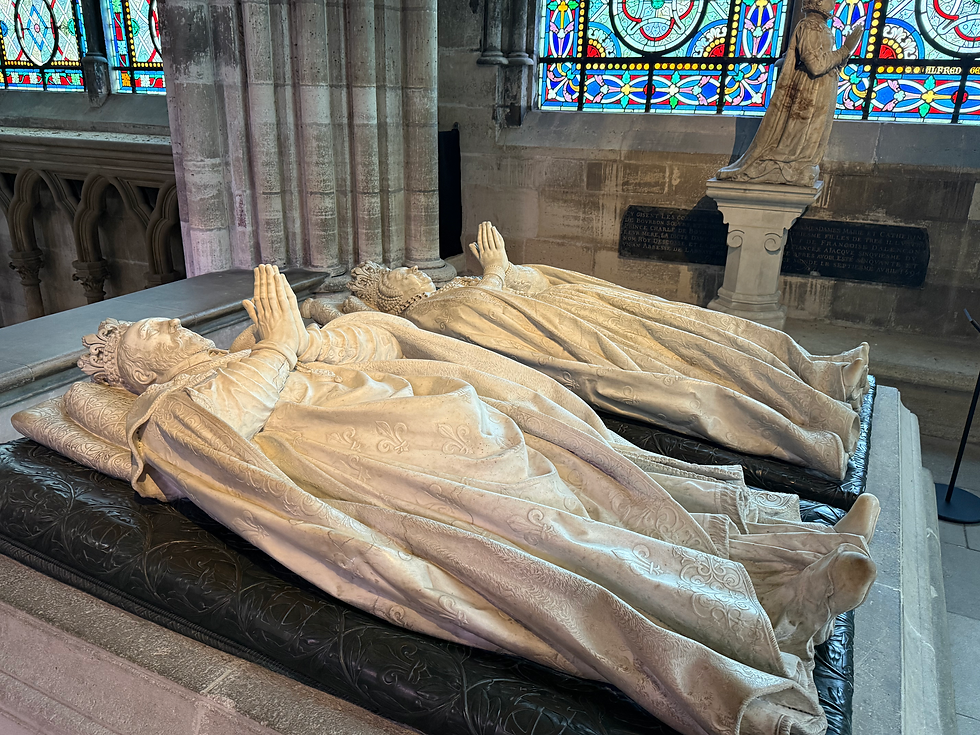
As you emerge from the crypt, you'll see additional tombs in the aisles adjoining the choir and the nave. One prominent tomb is that of Louis XII and Anne of Brittany who died in the early 16th century.

This is the tomb of Henri II and Catherine de Medici.
The stained glass windows are spectacular. This one is located in the north transept and depicts the genealogy of Christ.

Close-up.

Across is the south rose window with God at the center, surrounded by the Zodiac signs, the six days of creation and agricultural scenes.

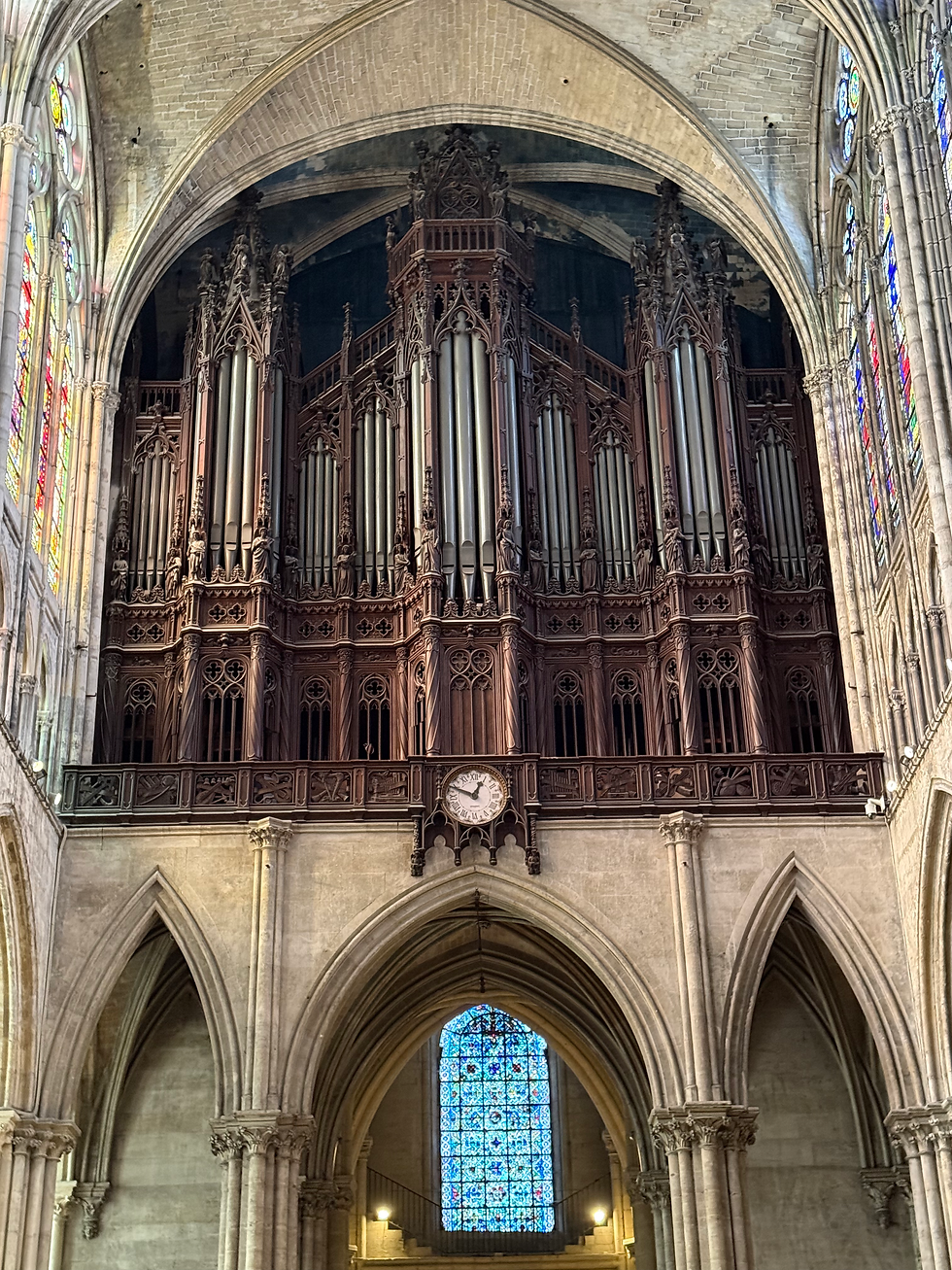
Additional views of this beautiful basilica.
The Exterior
The West front has three portals. This is the central portal depicting the Last Judgement. It dates from about 1135 and was restored in 1839.
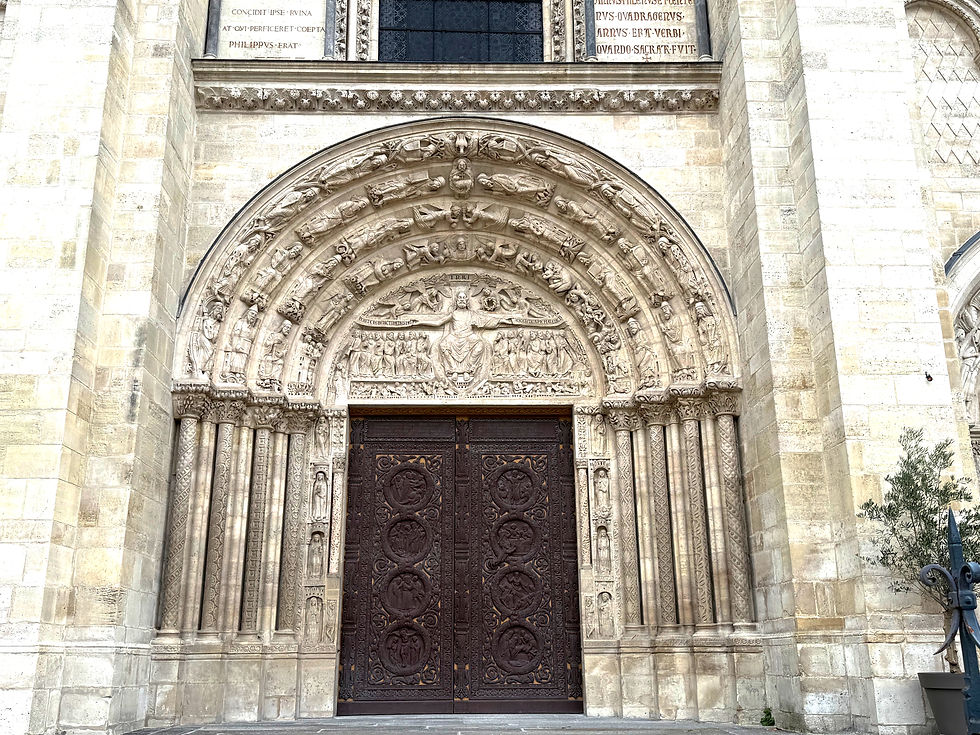
Close-up.
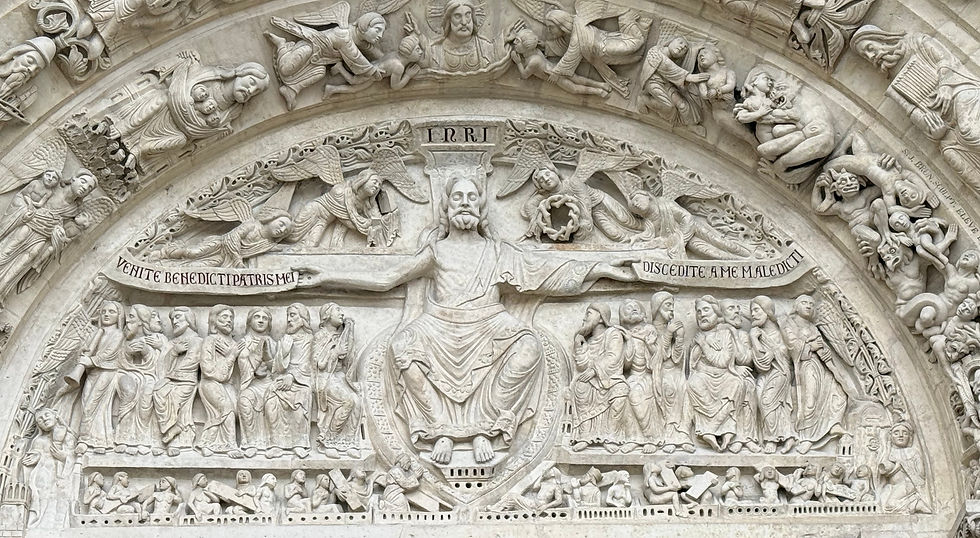
South portal.

The West front before cleaning. What a difference!

The north tower was struck by lightning in 1837, further damaged by a tornado in 1845 and was demolished soon afterwards. As of 2025 reconstruction on the north tower commenced in earnest and is expected to be completed by the end of the decade.

And Finally...
There is so much history associated with this church. I encourage anyone interested to read more about it and make time to visit it when you're in Paris.
➜ Top Tips
While not located in central Paris, St.-Denis is easy to get to. Take métro line 13 and get off at the Basilique de St.-Denis stop. But beware, this line splits prior to the stop, so be sure to board the correct branch. The basilica is just a short walk around the corner from the métro station.
Plan to spend at least one to two hours there.
The basilica itself is free, but there is a fee to visit the necropolis/museum.
As mentioned, your visit will be more meaningful if you read a little about it prior to visiting.
If you go on your own as opposed to a guided tour, rent the audioguide which is very informational.


Comments