
Namibia: Desert, Dunes and Amazing Animals
Updated: Aug 21

I had been searching for a safari for a long time, but every time I started, the job became overwhelming and I gave up. What country? What time of year? What company? And since I'd be on my own, I wanted to find a small group. Then I saw an ad for a nine-day safari in Namibia. Women only and a maximum of eight participants. It checked all the boxes; a combination of game drives and exploring the country, small group, 4-5 star lodges and beautiful scenery. I didn't know Namibia at all (in fact, I had to look it up on a map!) so it was an opportunity to experience something very different. Voilà. The trip took place in July which is winter south of the equator and Namibia's dry season. In fact, we didn't see a cloud the entire trip! Morning temperatures were very cold, but each day warmed up beautifully.
This map shows the location of Namibia and roughly shows our route during the nine days.

Namibia is about twice the size of California and 22% bigger than Texas. It's population is 2.8 million making it the second least-densely populated country in the world after Mongolia.
81% of Namibia is desert, principally the Namib, the oldest desert in the world, and the Kalahari. This is very evident both from the air and from what we saw on the ground driving through the country.


Namibia's main sources of income are mining (diamonds, gold, zinc, lead, copper and uranium), tourism (which is a rapidly-growing industry), fishing and agriculture. Its unemployment rate is high, just under 50%.
I had also wanted to visit Cape Town, South Africa for a long time, so I spent a few days there then flew to Windhoek, the capital of Namibia, to meet the group. We were then spirited off in our van which was our transportation for most of the trip. We drove from Windhoek south to the Kalahari desert for the first night. We had a "sundowner" in the desert, watching the sun set over the red sand while sipping a cocktail. Magic!


One of the first things we saw were these immense nests pictured below. They're built by social weavers, a sparrow-like bird native to South Africa, Namibia and Botswana. True to their name, they live with other social weavers in their nest community. As the families grow, they add to the nest creating "apartments" that can house hundreds of birds. The nests can weigh up to one ton and are often built in the sturdy camelthorn and acacia trees whose branches are usually strong enough to support them.

These little guys fascinated me.
The other interesting sight were these cone-like structures; termite mounds. There seemed to be hundreds of them scattered throughout Namibia.


Although I didn't see any particularly tall ones, they can reach 20 ft. in height. They're built of soil, plant fragments and termite saliva and they contain an internal chimney network to expel carbon dioxide, allowing oxygen to circulate and maintaining a stable temperature.
Animals
Of course, animals were the focus of the trip. We saw elephants, zebras, giraffes, lions, cheetahs, oryx, eland, springbok, ostrich, marabou stork, wildebeest, kudu, red hartebeest and many others.
As an animal lover and since this was my first - and probably only - safari, I was thrilled to see so many animals in their natural habitat. Most of the time they were oblivious to our presence which reminded us that we were visitors on their turf.
Elephants

Our first major game drive was to see the desert elephants outside of Twyfelfontein. Translated, Twyfelfontein means doubtful spring referring to the early inhabitants who didn't know when or where they would obtain their water. These elephants have adapted to the desert environment over the years, They're able to go up to five days without water and their feet are wide, enabling them to more easily walk on sand. They're herbivores and they travel 40 or more miles a day eating up to an amazing 550 lbs. of food daily.
They usually travel in small groups led by the matriarch with young ones in tow. Males generally travel alone. Interestingly, they're either right or left-tusked like humans are right- or left-handed. The herd expels the males by the age of 15; nature's way of preventing harmful inbreeding.

We also saw hundreds of these beautiful creatures at the end of our trip at a watering hole in Etosha Park in the northern part of the country. We spent over an hour watching herds come to and go from the water. The other animals, especially smaller ones, give a wide berth to the elephants at watering holes.
Notice in the video below that the elephant shoos away these guinea fowl.

Zebras

We saw scores of zebras. These plains zebras thrive on open grasslands but unlike the desert-adapted elephants, they need water just about every day so we often saw them around watering holes. Their stripes are unique to each individual, like human fingerprints.

Cheetah

We were fortunate to see this mama cheetah. She had just killed a springbok although she had not started to eat it.


Giraffes

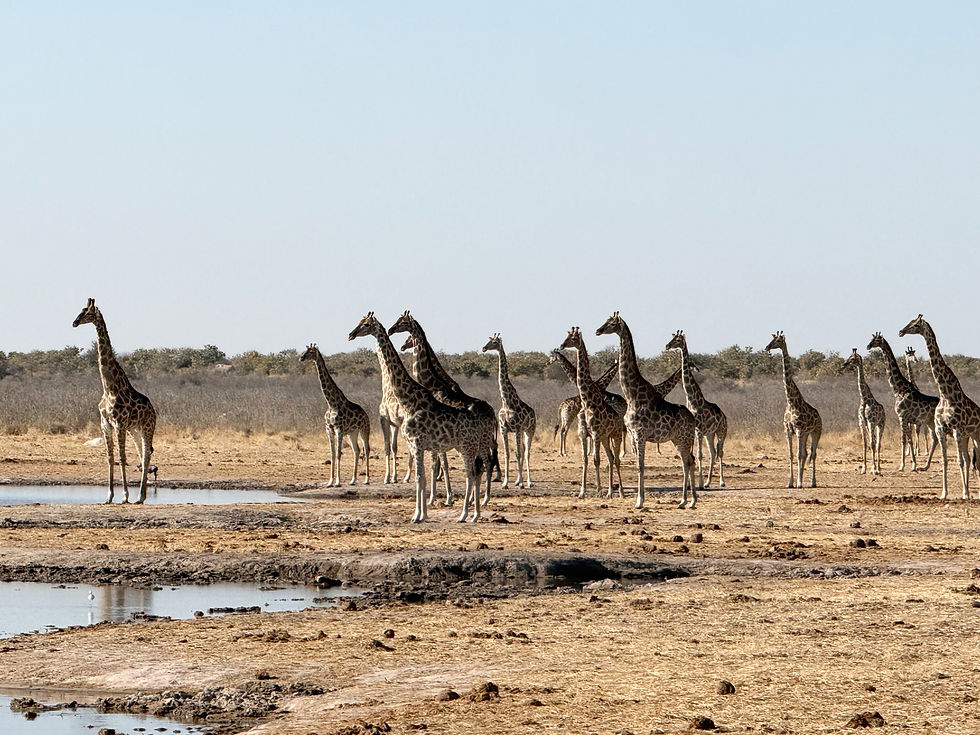
It's hard to choose, but if I had to, the giraffes are my favorite. Their faces are sweet and they move gracefully despite their long, gangly legs. We saw them traveling solo as well as in large herds.


Typical herds range from 10 to 20 individuals although unlike other species, they have no particular leaders and bonds are very loose.

They seem to glide almost effortlessly, appearing to move in slow motion.

Lions

We had several lion spottings and each was thrilling.

Female lions do the vast majority of the hunting. Their bodies are more sleek than the males' and the manes of the males tend to slow them down.

Watch these springbok and zebras exit en masse when they see the lions approaching the watering hole!
Then he and his mate had the watering hole to themselves!
Lions will drink about five cups of water a day.
The photo below is at a watering hole in Etosha National Park. This female was sizing up everyone - elephants, giraffes, zebras, springbok, warthogs. She eventually decided to lie in the tall grass then walked away, evidently not hungry.

Oryx
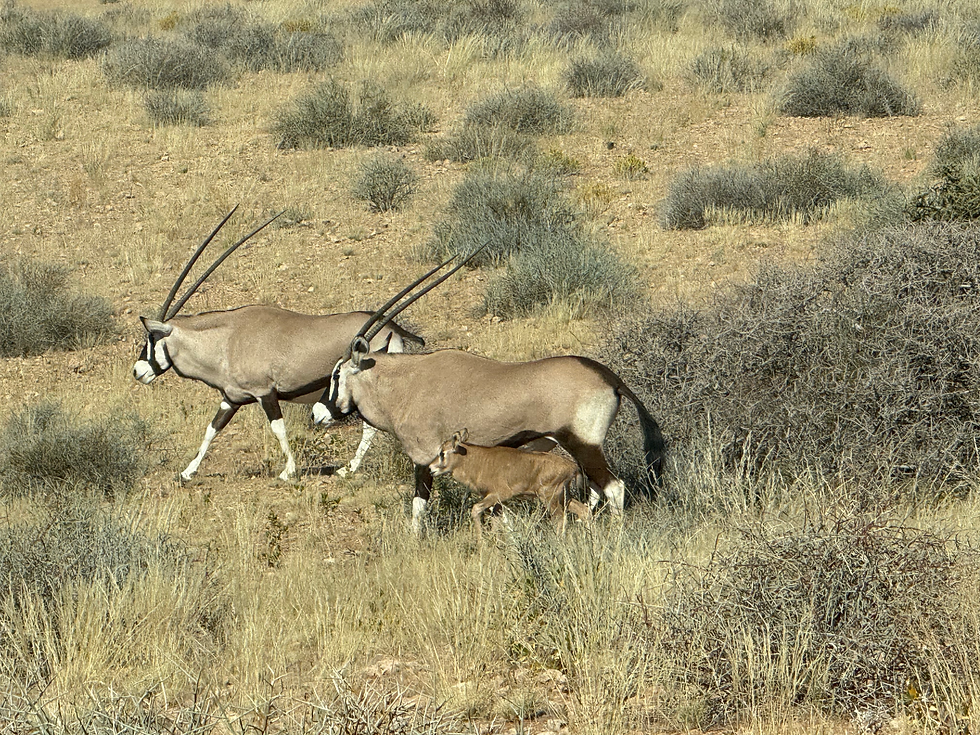
The oryx is the national animal of Namibia. They, too, have adapted amazingly well to their environment. They can regulate their body heat up to 113 degrees and a special network of blood vessels cool their blood before it reaches their brain. Like the desert-adapted elephants, they can exist without water for long periods of time. They get moisture from roots and succulents, enabling them to last for many weeks or longer without drinking water. And like the elephants, their hooves are wide, enabling them to effectively roam on the desert sand.


The oryx is depicted on the Namibian coat of arms, symbolizing courage, elegance and pride.
Blue Wildebeest
This species is native to parts of Namibia and we saw them often as we drove through the country, but especially in Etosha National Park.

They weigh between 260 and 600 lbs. and can run up to 50 miles per hour. Babies can stand and run within minutes of being born to keep up with the herd. They can live up to 20 years in the wild.


The video below was taken from my room at our lodge on the edge of Etosha National Park.
Ostriches

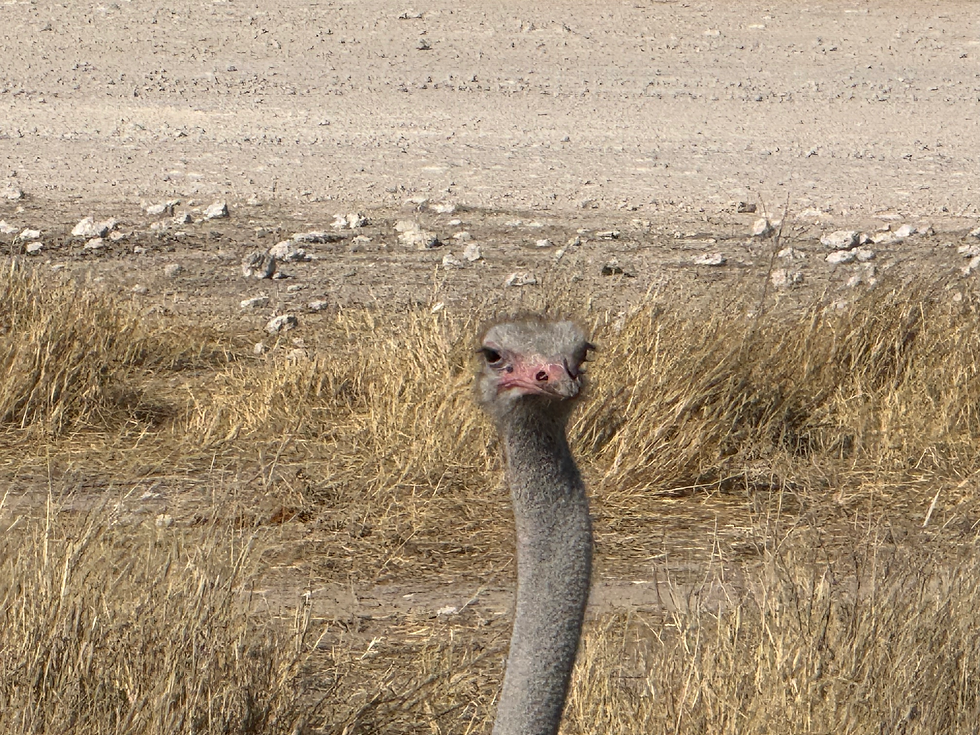
We randomly spotted a number of ostriches as we crossed the country. The black ones are males; females are brown. The ostrich's brain is the size of a pea and they can run up to 45 mph.

We spotted this ostrich egg in the Kalahari desert. One ostrich egg is equivalent to 23 chicken eggs.

Springbok

Springbok were everywhere. We must have seen hundreds over the nine days. It reminded me of the ubiquitous deer population in the northeastern part of US where I live.

Compared to the larger animals, they're slender and sleek, able to run at speeds up to 60 mph. Similar to some of the other animals we saw, they can live without drinking water for long periods of time, relying on the moisture from roots, shrubs and grass.
Other Animals
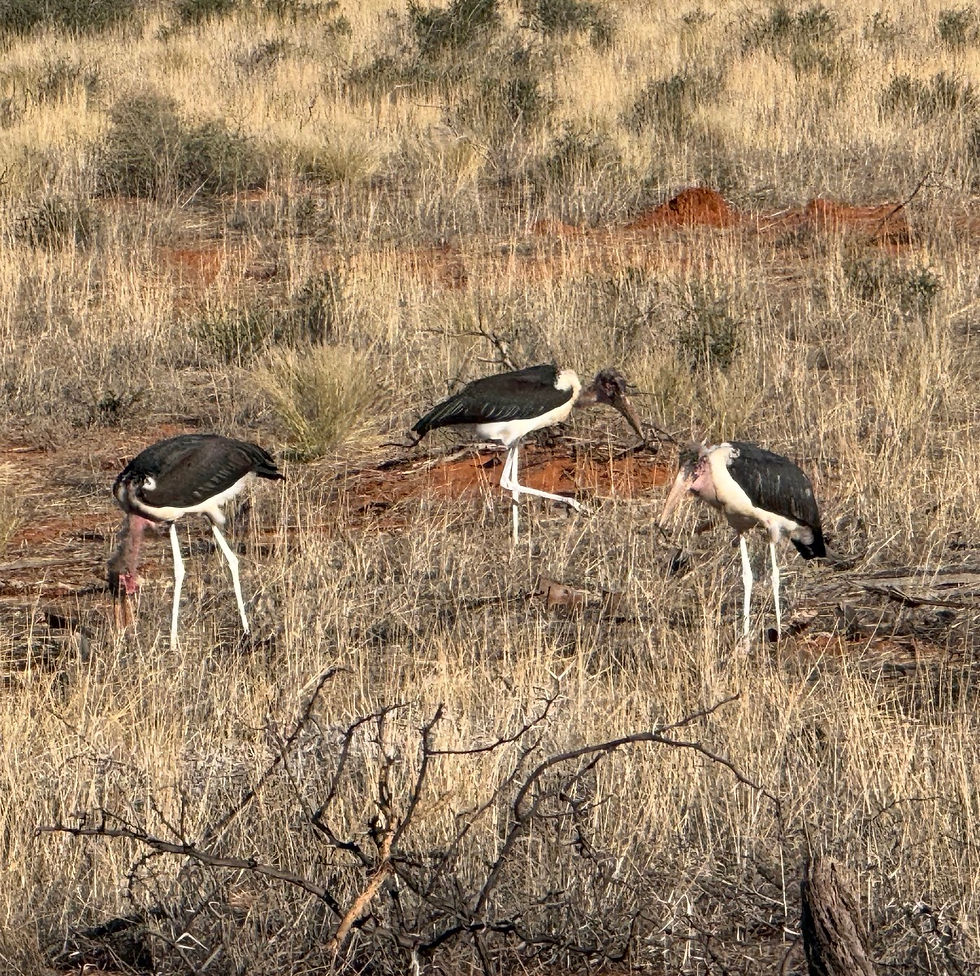
We also saw red hartebeest, marabou storks, warthogs and a beautiful spotted owl.



On and Above Land
As I mentioned, animals were a major factor in my choosing this trip, but the other opportunities to experience Namibia were also key.
The Dunes and Deadvlei

Located in the Namib-Naukluft National Park near Sossusvlei, these dunes rise magnificently over the surrounding desert. "Big Daddy" is the tallest, soaring 1,000 ft. above the ground. While a few of us stayed on terra firma, several of our group were brave enough (and in good enough shape) to climb it! Climbing takes about 1 to 1.5 hours.
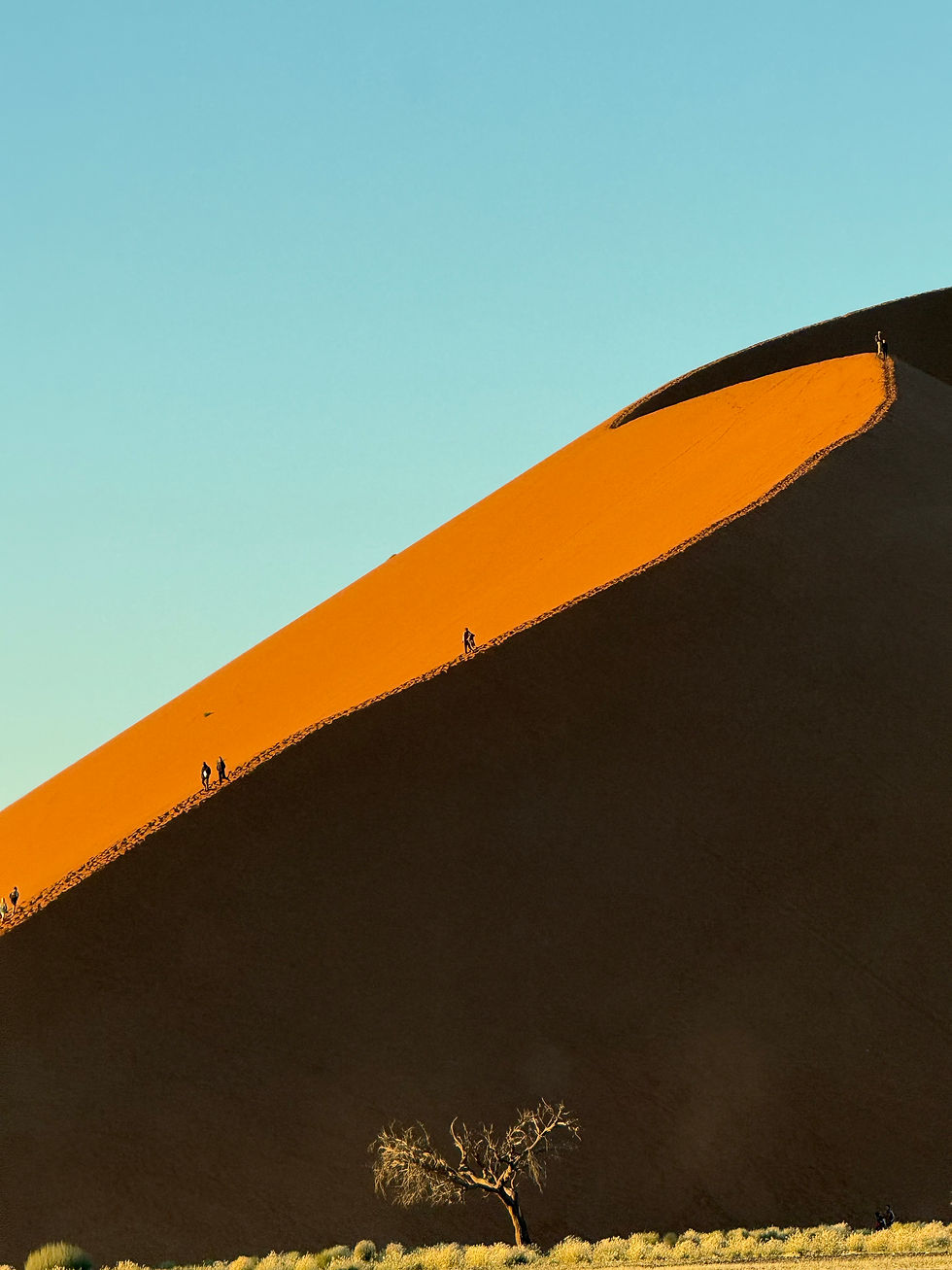

NASA satellites show that these dunes can shift up to about 100 ft. per year with the winds, changing the landscape as they travel. Smaller dunes can move up to almost 300 ft. per year. Our guide told us that the dunes with vegetation growing on them shift much less or not at all.

I loved how the shadows played with them.
Deadvlei

Sitting in the shadow of Big Daddy and the surrounding dunes, Deadvlei has been frozen in time. Translated, Deadvlei means dead marsh. It's actually a dry clay pan which, over 900 years ago supported trees and other growth thanks to the river that flowed through it. Eventually drought hit and the dunes blocked the river from the area. Over centuries the sun scorched the trees and the dry atmosphere prevented them from decomposing, leaving the black skeletons we see today. It's a fascinating area and I spent a considerable amount of time walking through it.
Below is what we walked through to reach the area.
Truly a memorable day!
Our Hot Air Balloon Ride

We had an opportunity to take a hot air balloon over the desert and dunes. Getting up at 3:30 a.m. was worth what was ahead of us.
It was a crisp morning as usual, but the views at sunrise and during the time we were airborne were spectacular.
The desert had an almost jade-green tint. We were told that there had been a recent, rare rain that caused the desert to bloom.
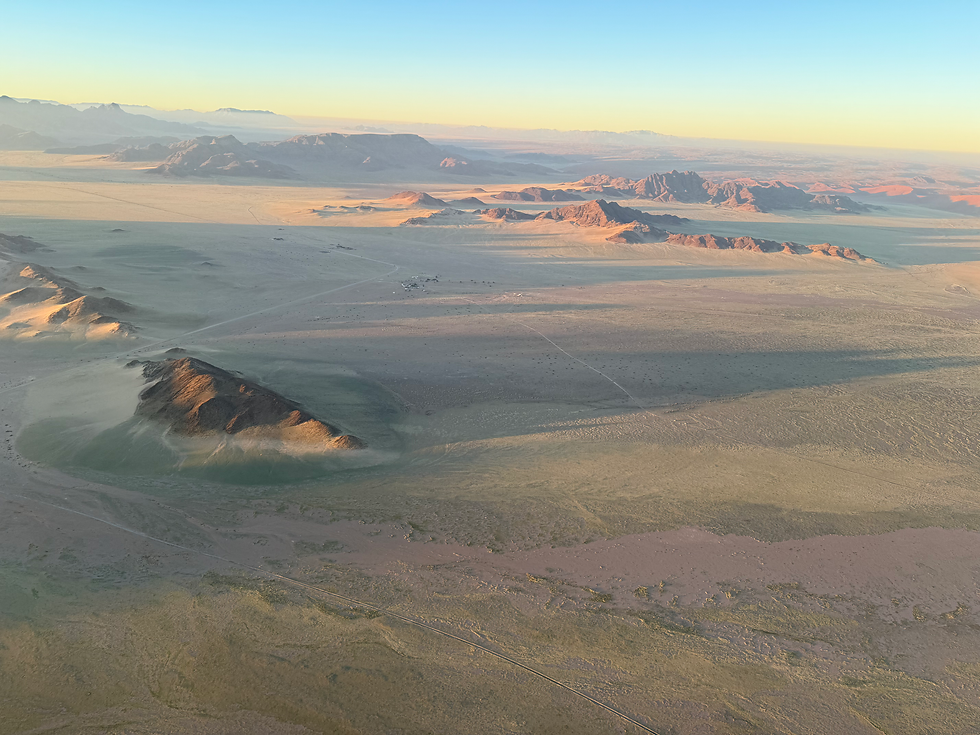


After landing we were treated to a delicious champagne brunch in the desert. Pinchworthy!
Another truly memorable day!
Birds' Eye View
To drive from where we were in Sossusvlei to our next stop, Twyfelfontein over 400 miles north would have taken almost 9 hours. Instead, our tour company arranged a charter flight. Whether it was preplanned or simply by luck, our pilot told us he was going to make it into a scenic flight for us. We were in for more stunning scenery.
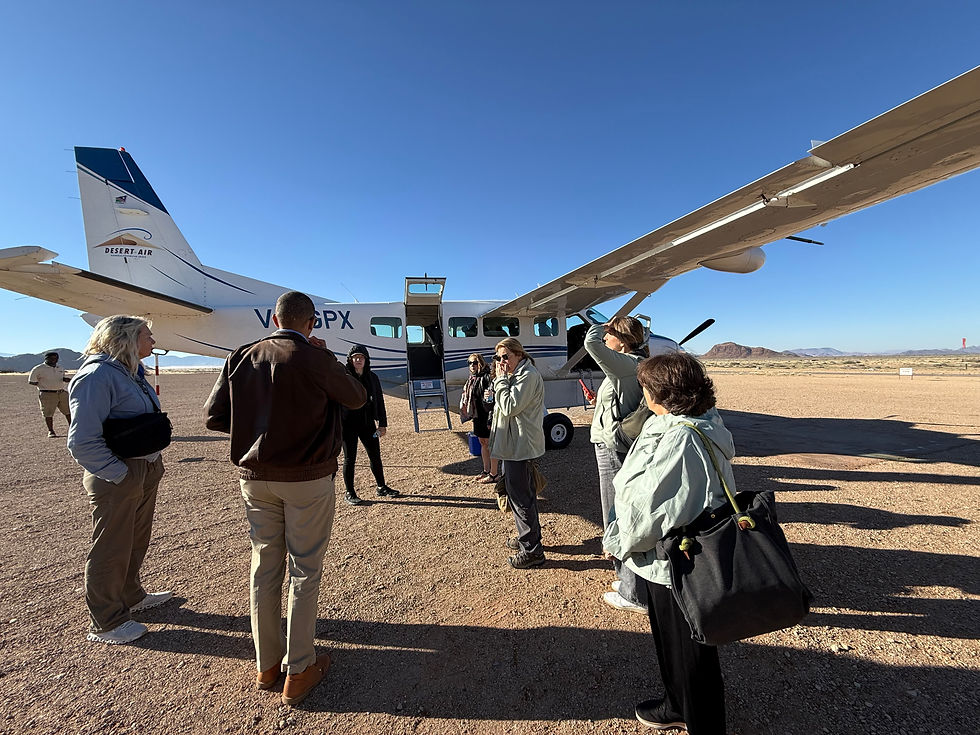

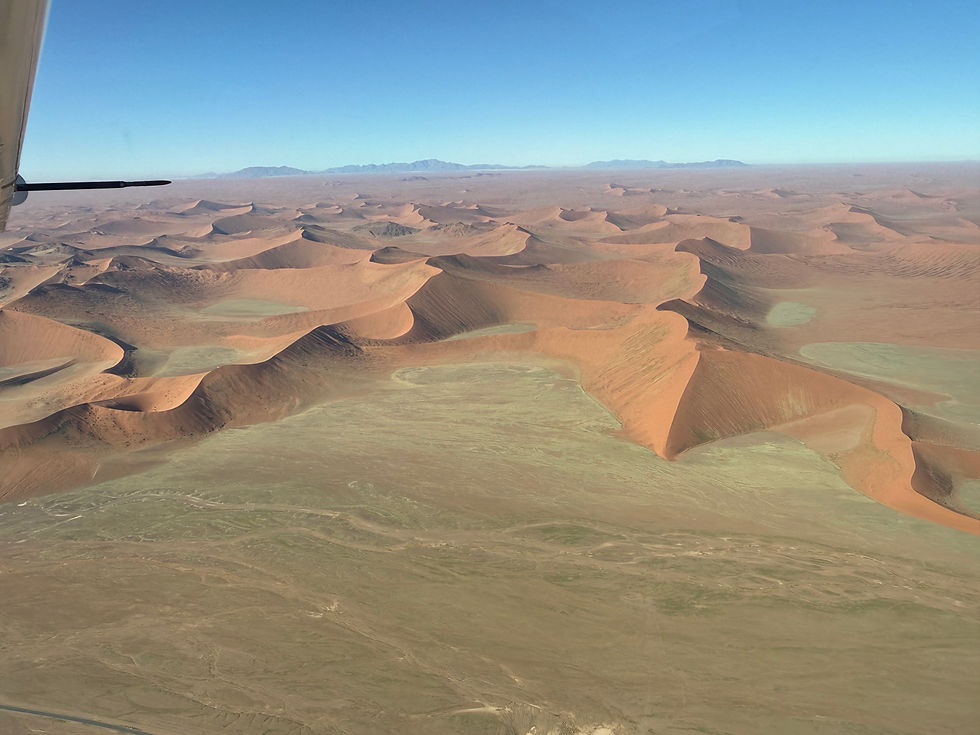
He flew us over the dunes we had visited just a couple of days before.




The coast was fogged in, but he was able to fly beneath it so we could take a look. This is called the Skeleton Coast thanks to the skeletal remains of ships that fell victim to the Atlantic currents, fog and shifting sandbanks. Wrecks have been found dating from the 1500's to as recently as 2008.
The dunes come right up to the waves.
Below is the Brandberg, the tallest mountain in Namibia at 8,442 ft.

Damara Living Museum
After we arrived in Twyfelfontein, we spent part of an afternoon at the Damara Living Museum.

The Damara are an ancient indigenous ethnic group in Namibia. They make up 8.5% of the population of Namibia and most live in the northwestern and central parts of Namibia. This museum is just outside Twyfelfontein. They speak Khoekhoegowab which features the distinct click. Listen below.
The museum showcases the way of life of the Damara people in an attempt to keep the culture alive. Proceeds from admission fees go to the community. It was interesting to learn about their history and culture.
These men are building a fire.
The visit ended with a short performance for us.
Landscape and Lodges
I was intrigued by the relative diversity of the landscape in Namibia given the fact that the vast majority of it is desert. From the red sand of the Kalahari and Sossusvlei to the beautiful rock formations of Twyfelfontein and the tall grasses of Etosha, it was interesting to see the variety.
The Landscape


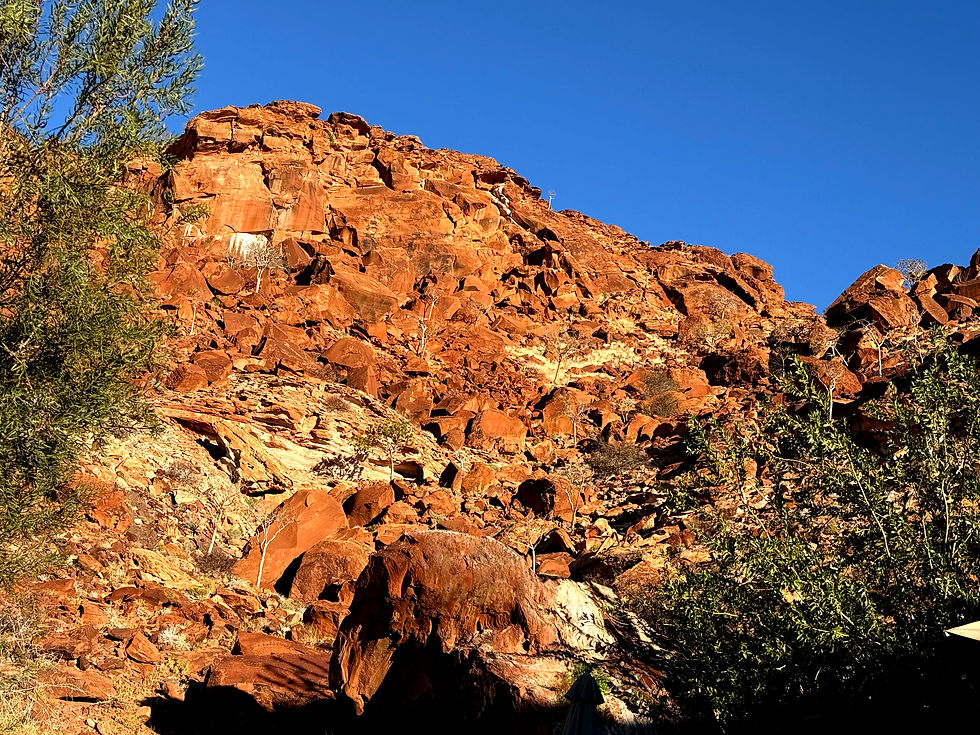


Our Lodges
Several of our lodges were noteworthy and two of them had private plunge pools although they weren't heated so a bit difficult to take advantage of. I'm sure they're a welcome sight in the summer months!
The Desert Grace

The Desert Grace is about 180 miles southwest of Windhoek in the Namib desert. We used it as our base for the dunes and the hot air balloon ride. In addition to being one of the nicest lodges we stayed in, its distinction is that it's entirely made of the sand from the Namib desert.

Each room is a separate structure with its own plunge pool.

The Twyfelfontein Country Lodge

While not as upscale as The Desert Grace, this lodge was unique due to its being built - incredibly - into the surrounding rocks.


Etosha Safari Lodge

Tucked into a lovely setting just a few minutes from the south entrance to Etosha National Park, The Etosha Safari Lodge was also memorable. It sits high above the surrounding landscape which to me at least, looked like trees turning bronze in autumn.

Each room was a separate building with a lovely path to the main buildings.
The rooms have a balcony overlooking the desert floor which seemed to stretch forever.
As in most of the other lodges, the sunset was incredible.

King Nehale Lodge

This was perhaps the best of the lodges. Again, each room is a separate building and each has a plunge pool. My shower was huge!
This lodge owns its own private watering hole where we enjoyed a bird's eye view of elephants, giraffes, zebras and other animals.

We were at the northern edge of Etosha National Park. There were wildebeests grazing in the tall grass behind my room each day.
Another beautiful sunset.
Final Thoughts
Those nine days were an insight into the nature and habits of the incredible animals we were fortunate to see as well as a quick glance into the culture, landscape and people of Namibia.
The seven other women I traveled with, with one exception, had never met each other. We were all well-traveled and we thoroughly enjoyed each other's company. I'd happily travel with any of them again.
Here are a few final glimpses.

Every safari is different and every country is different. What I know is that Namibia was an excellent first experience for this neophyte.

➜ Top Tips
I'm certainly not an expert, but the following might be helpful if you're planning your first safari.
Respect the animals and remember that you're on their turf.
Take appropriate clothing. The desert can get very cold in the morning and night, but warm up considerably during the day. I took layers and was glad I had something warm.
Take proper sun protection.
Take a neck gaiter to cover your face. It will protect you from the sand when you're traveling fast in an open safari vehicle.
Take binoculars and a camera that can capture photos from a distance (unless you're an excellent photographer in which case you'll know what to bring!).
Take appropriate shoes especially if you plan to do any hiking. I took my daily sneakers which were fine.
Take a water bottle and don't underestimate how dry the desert is; drink plenty of water.
Comments