
Three Days in Cape Town, South Africa
Updated: Aug 10

I've been intrigued with Cape Town and have wanted to visit it for a long time. Living in Upstate New York, it's not a quick weekend trip. Or inexpensive for that matter. When an opportunity to go on a safari in neighboring Namibia came up, it was the perfect opportunity to finally visit. This voyage isn't for the faint of heart. I flew from my hometown to JFK, then to Amsterdam for the 11-hour trip south, about 30 hours door-to-door.

The safari took place in July which is winter south of the equator. Winter in Cape Town can be cool, windy and/or rainy. It can also boast beautiful, sunny days which I was fortunate to have while I was there. I chose a hotel in an area called Sea Point which is along the Atlantic Ocean. There is a promenade along the rugged beach which is full of joggers and people walking dogs, perfect for stretching your legs and enjoying the natural beauty after a very long flight.


Cape Town Walking Tour
There's a lot to cover and learn in a city of 5 million people. Three days is barely enough to scratch the surface of this area and to understand its complicated history. I like walking tours when I go to a new city so I chose a two-hour tour and as luck would have it, it turned into a private tour as I was the only person who signed up. We began in the central part of the city.
We walked past Desmond Tutu's house. An anti-apartheid and human rights activist, Tutu was an Anglican theologian. He was named Archbishop of Johannesburg and finally Archbishop of Cape Town from 1986 to 1996.

While not a museum, this former residence houses a "Truth to Power" exhibition which highlights Tutu's life and fight against apartheid.
This is St. George's Cathedral also known as the People's Cathedral, Tutu's seat as Archbishop. It became a gathering place for anti-apartheid activists during the 1980's.

Company's Garden is a serene, beautiful green space and botanical garden in the center of Cape Town. Its name stems from the the Dutch East India Company which founded the garden in the mid 17th century to provide fresh produce to ships passing through the area. It is the oldest garden in South Africa and a world heritage site. I walked through a small part of it with my guide but I wish I could have seen more.

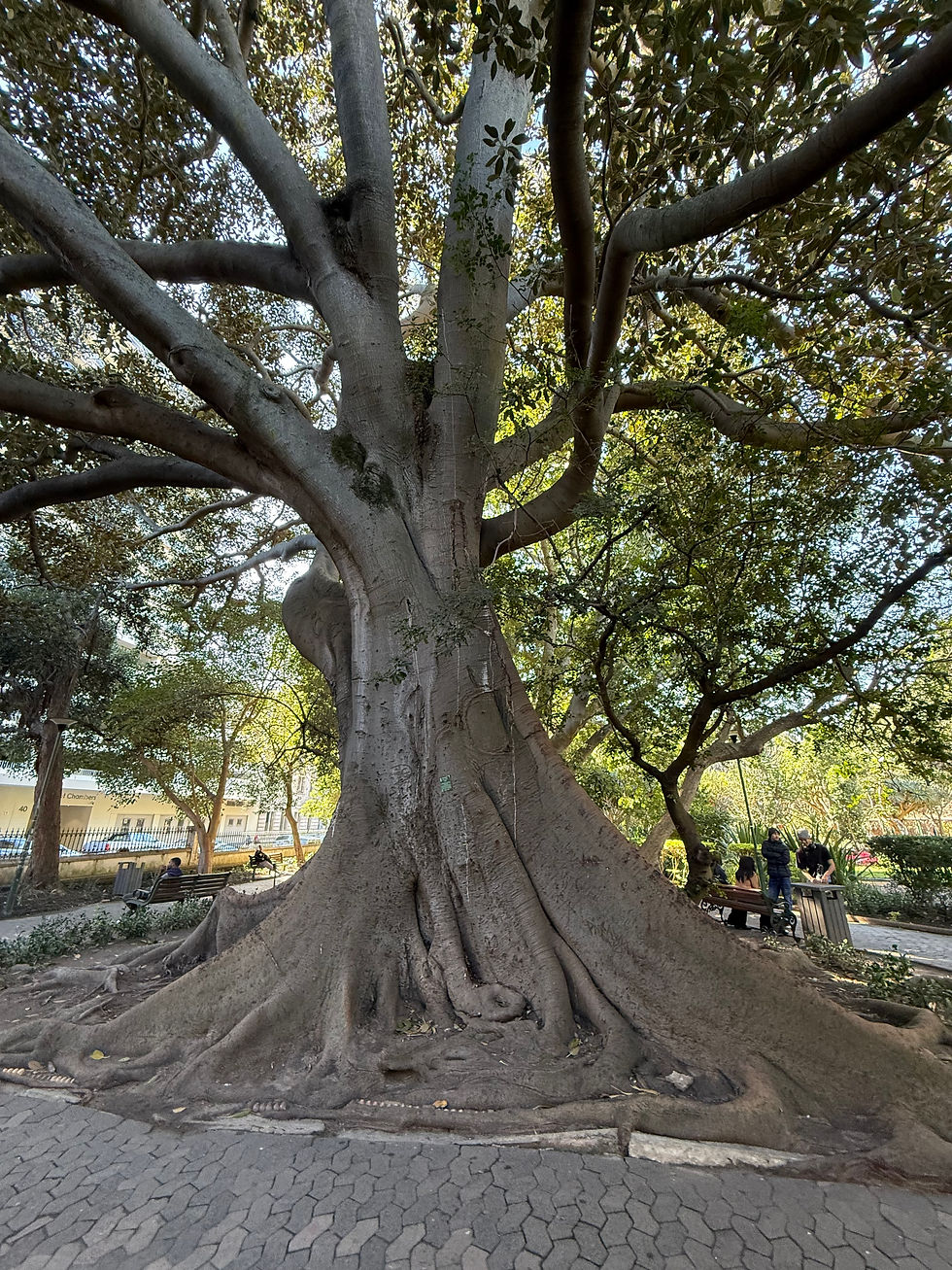
This display was at one entrance of the garden. I found it colorful and attractive and bought a painting from the young artist.
Of course no tour of Cape Town would be complete without a nod to the decades the people of South Africa suffered under apartheid. Nelson Mandela spent 27 years in prison for his fight against apartheid and was finally released in 1990. Hours after his release he delivered a speech from City Hall which inspired millions in South Africa.

These benches were chilling to see. Legal segregation was enforced by law from 1948 to 1994. The benches are an art project which was installed in 2006.

There are 11 polished black granite blocks which form the Cape Town Memorial to the Enslaved. Each block is engraved with either names of slaves or the treatment they underwent. It was a powerful exhibit.

If you read closely, notice that many names below stem from the country from which they came to South Africa.

The tour ended in a section of Cape Town known as Bo-Kaap. This neighborhood of colorful houses and cobblestone streets is historically significant. The name means "Above the Cape" due to its position overlooking Cape Town. Formerly known as the Malay Quarter, it is the oldest surviving residential area of Cape Town.

The neighborhood was established in the latter half of the 18th century as residences for slaves, many of whom were brought to the area from Malaysia and Indonesia. Many of them were Muslim and today over 50% of this neighborhood identify as Muslim.
The houses were originally all white, but the bright colors they're painted now celebrate the eventual freedom of expression granted to the residents.


Below is the oldest house in Bo-Kaap, located at 71 Wale Street. Built between 1763 and 1768, it is the oldest residence that remains in its original form. It serves now as the Iziko Bo-Kaap Museum.

If you visit Bo-Kaap, try a Bolla, a soft, donut-like treat dipped in cinnamon sugar syrup and rolled in coconut.
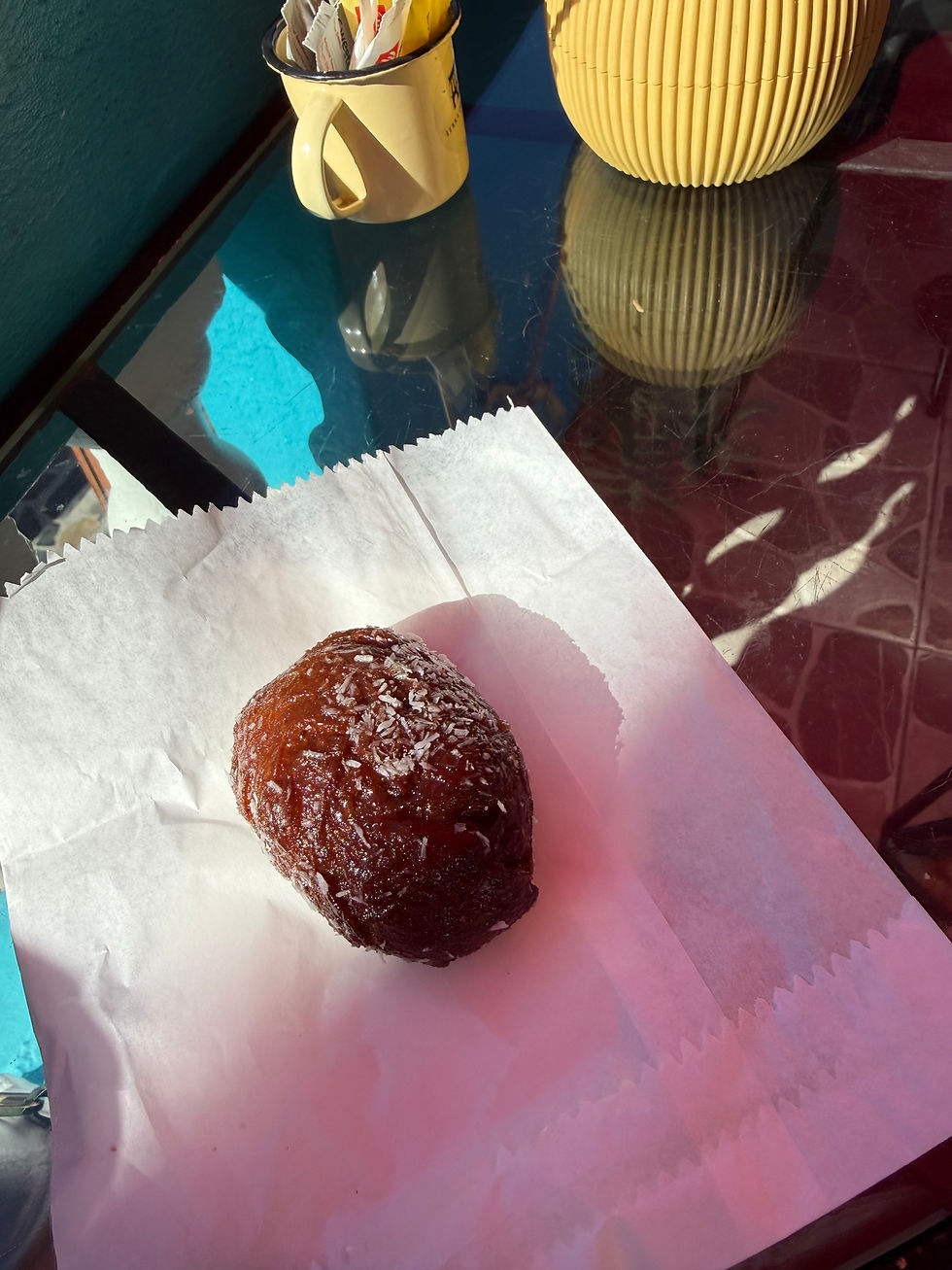
A few more photos of this colorful neighborhood.
After the tour I walked around the Victoria & Alfred (V&A) Waterfront, a 304-acre area of shops and restaurants built around Cape Town's working dock. Alfred was Queen Victoria's second son who began construction on the breakwater basin in 1860.
At first glance this row of rhinos looks like an art exhibit. It is, but it's also a commentary on the poaching of rhinos in South Africa.
I took a relaxing sunset boat tour of the harbor which affords beautiful views of Table Mountain, perhaps Cape Town's most well-known landmark.
Cape of Good Hope, Penguins and Beautiful Views
My second day in Cape Town was unforgettable. I took an all-day drive with a small group down the peninsula to the Cape of Good Hope. The day began foggy and misty but soon became crystal clear. We drove along Chapman's Peak Drive, a scenic, winding road along the coast with 114 turns!
This video was taken at an area called Clifton, just above Camps Bay which is a beautiful, upscale area just south of Cape Town. The scenery is breathtaking.
I captured the photos below just before the fog began to burn off.


We spotted this little guy at one of our scenic stops just south of Cape Town. It's a dassie, or rock hyrax, a mammal common to South Africa. Interestingly, they're related to the elephant in that they develop tiny tusks and share other anatomical features.

Hout Bay is a harbor town south of Cape Town. It's possible to take a cruise to see the Cape fur seals nearby, although having seen many seals in my life, I stayed behind and enjoyed the harbor. This guy was hanging out to greet visitors.


As the fog lifted, we enjoyed the scenery heading south. The photo below shows Hout Bay, where we had just been, in the distance.

A significant part of the drive was spent going through the Cape Point Nature Preserve, an 18,000-acre parcel of land which is home to a variety of animals such as eland, steenbok, bontebok, ostrich and others.


The male ostrich is black; the female is gray. Their brain is the size of a pea and an ostrich egg is equivalent to 23 chicken eggs.
We saw several eland which were very large!

This guy wasn't bothered by us at all!

We finally reached the Cape of Good Hope. Contrary to popular belief, it's not the southernmost point of land in South Africa, but stunning nevertheless. I had to pinch myself that I was standing there!


Heading back north, we stopped at the Old Cape Point Lighthouse. This lighthouse has an interesting story.

Constructed in the late 19th century and sitting at 816 feet above sea level, it's been inactive since 1919. Ships approaching the Cape often saw its light "too early", causing them to approach land too closely, resulting in crashing into boulders near the shore. Additionally, the weather at the Cape tends to be cloudy, so the lighthouse was often obscured by clouds and therefore unusable. A new lighthouse was built only 2,300 feet from the old one, but much lower, at 285 feet above sea level making it much less affected by fog and clouds.
Take the Flying Dutchman Funicular up to the base of the lighthouse and you'll be rewarded with these breathtaking views.
Once you reach the base, it's possible to climb up to the lighthouse.

Penguins and More Penguins!

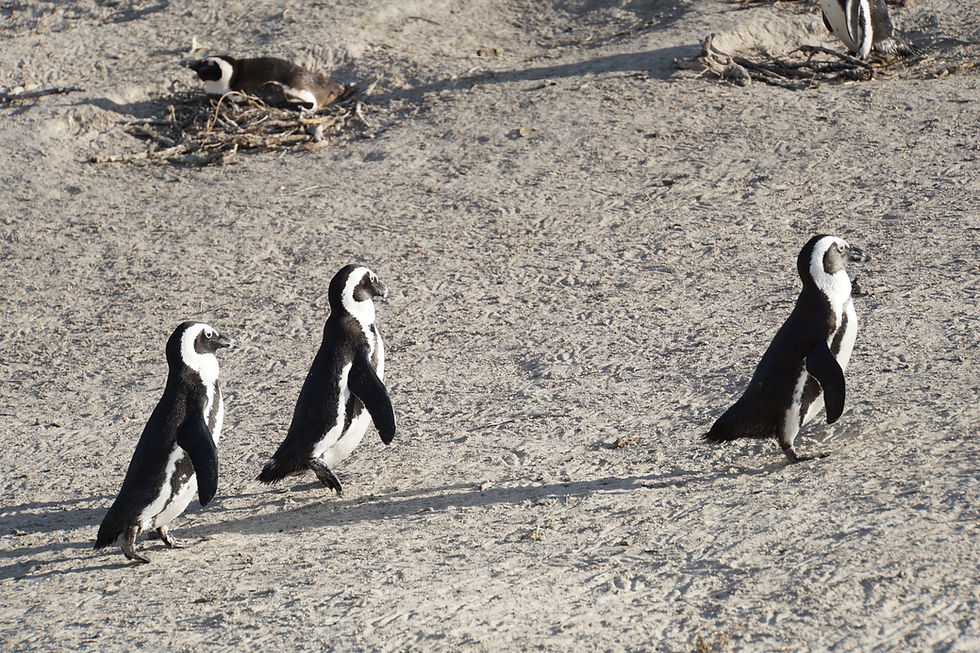
The next stop was one I had been anxiously anticipating for for a long time. I had heard about the penguins in Cape Town for years and finally had a chance to see them up close and personal! These adorable creatures are African Penguins, the only penguin species in South Africa. They reside at Boulders Beach on the eastern side of the peninsula.
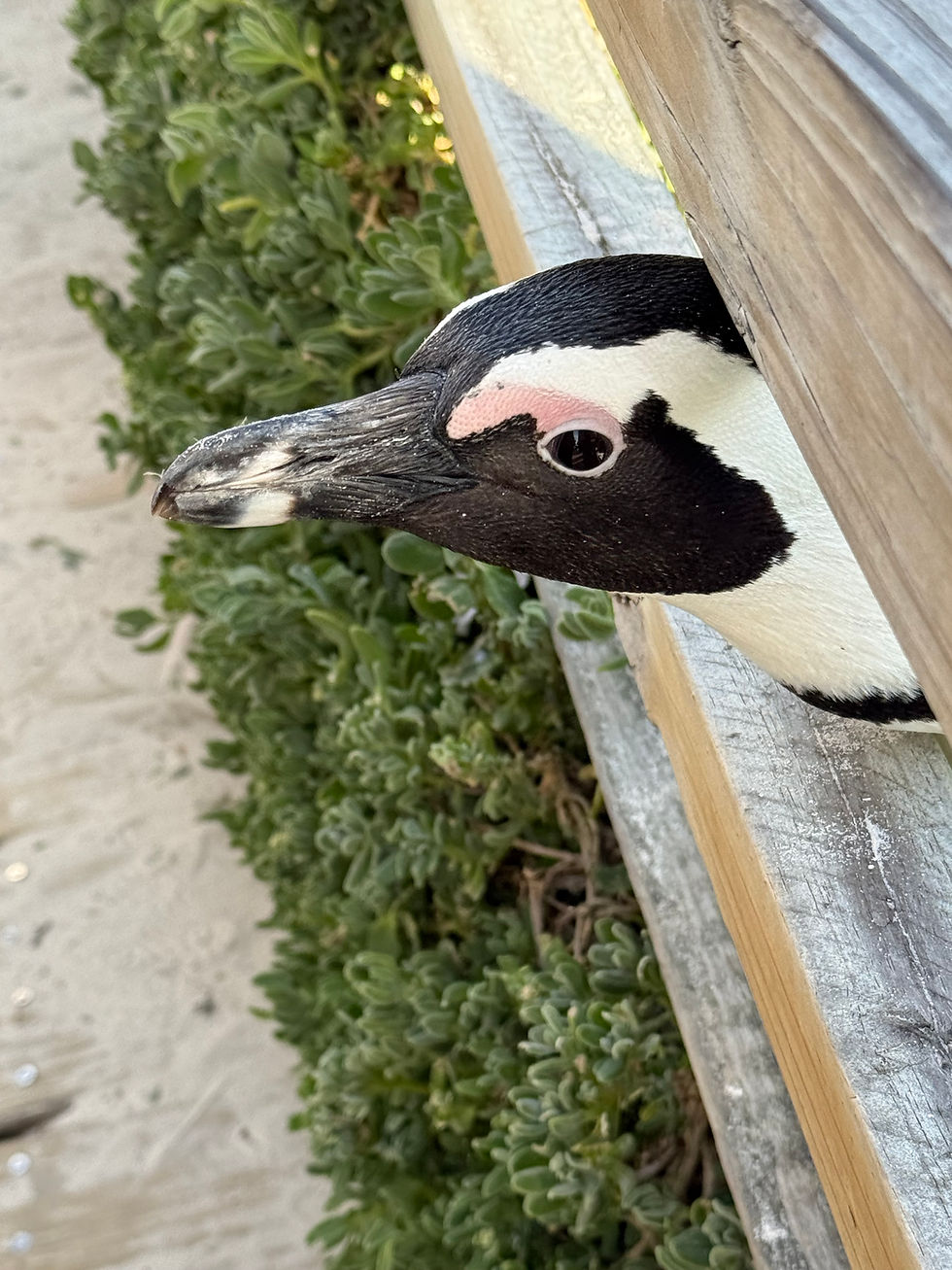
Fun penguin facts:
They mate for life

Parents share the responsibility of incubating the eggs over a 40-day period
Chicks are covered with soft downy feathers which insulate against the cold, but absorb water so they can't enter the ocean until they molt


The patch of bare skin above the eyes is a cooling mechanism

They weigh from 4 - 11 lbs.
The black spots on their chest are unique to each penguin


They drink seawater which is filtered through a gland and the salt is sneezed out
They live for 10 - 15 years in the wild

They can dive to 425 feet and reach speeds of 12 miles per hour when swimming
I could have watched them all day!
The final stop of our day was Muizenberg beach. Located on the eastern side of the peninsula, this beach is known for its brightly colored cottages.

It lacks the rocks found on the Atlantic side and the waves are gentle making it a good location for surfing. The water is also warmer as it comes from the Indian Ocean.


Sunset over the Atlantic Ocean from my hotel room at the end of a perfect day.

This map shows the peninsula and the ground we covered. I've taken many day trips in my travels, and this was among the best!

Wine Tasting and the Western Cape

On my third and final day in South Africa, I headed to the Western Cape for a half day of wine tasting. The landscape is stunning and the two wineries I visited were beautiful and offered excellent wine. Again, I was the only person on this tour; an advantage of going in the low season!
The first stop was Fairview Winery in Paarl, the largest city in the Western Cape province. Fairview is also a working farm. The property now occupied by the winery was first designated as a farm in 1693.

Fairview raises goats for their cheese. The tasting paired their delicious cheeses. I loved their wines, especially the Pinotage, a signature South African red wine.
Their lovely property.
The second winery was Marianne Wine Estate just minutes away outside the lovely town of Stellenbosch. The owners are originally from Bordeaux. They bought the winery in 2004 and they pride themselves on combining the best of French techniques with South African vines. They pair their wines with dried springbok, kudu and beef. We call it jerky; in South Africa it's biltong.

They also grow lemons and clementines amidst a beautiful setting.

Stellenbosch

This quaint city of about 127,000 residents is nestled among the surrounding vineyards.. It's home to Stellenbosch University, one of the oldest universities in South Africa. I enjoyed strolling down its main street of mostly white buildings, giving it a sunny, summer vibe.
The sculpture below is a commentary on "the tensions around habitat and space between humans and animals in the Western Cape".

On our way back to Cape Town, we passed a series of what is called Townships. In South Africa townships are a symbol of apartheid and pre-apartheid-era segregation. Black Africans were taken from their communities and forced into racially segregated urban areas. These are along the N2 highway just outside Cape Town. Living conditions for most residents are basic at best and crime and unemployment rates are high in most of them. It was eye-opening to see them even fleetingly from the highway and a stark contrast to the beauty and opulence I had seen the two days prior.
In Summary...
Three days barely even scratched the surface. There were so many things I didn't do such as take the cable car to the top of Table Mountain to take in the view, visit the museums which tell the story of apartheid and South Africa's past such as the District Six, Slave and Bo-Kaap museums, explore the botanical gardens, spend more time in Company's Garden and walk around central Cape Town. I would also like to spend more time in the Western Cape enjoying the wineries and beautiful scenery. The people I met were warm and welcoming and although I didn't go out at night, I felt safe. I hope to return someday to explore the area in more detail.
Here are some parting shots of this wonderful city and surroundings.

➜ Top Tips
If you come from North America, this is a long trip, similar to going to Asia or Australia. I splurged and booked business class which made the flights much more bearable. My return flight from Cape Town to Atlanta was 16 hours and it helped tremendously to be able to lie flat to sleep.
Three days in a city doesn't make you an expert on anything, but my advice would be to consider staying at the V & A Waterfront or Sea Point where I stayed. I will definitely stay at the same hotel if I go again.
Uber is widely used in Cape Town.
Try to get out of the city if you can; the countryside is beautiful.
As I mentioned, I went in July which is the middle of their winter. I was lucky to have beautiful weather as it could have been rainy and cloudy. If I go again I'd go in the shoulder season when there's a good chance of sun and the crowds are fewer than in the summer.
I would spend at least a week exploring the city and surrounding area.
Make sure you go down the peninsula!
Be aware of your surroundings. Although I felt safe, I was always on alert.
Comments